


REAL-WORLD A.I. IN PRACTICE
In Episode 6.13, Dr. Joshua Lowentritt joins host David Mandell to explore the rapidly evolving role of artificial intelligence in medicine. Dr. Lowentritt shares his 25+ year journey as a practicing physician and healthcare leader, highlighting how Hurricane Katrina reshaped his professional outlook and entrepreneurial path. From building physician-owned organizations to investing in startups, his career reflects a deep commitment to improving healthcare delivery. Today, that mission increasingly centers on leveraging AI to enhance both physician experience and patient outcomes.
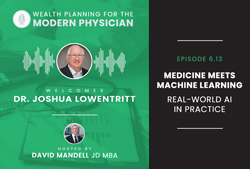
(Video Available February 18, 2026 at 6 AM Eastern)
A central focus of the conversation is the use of AI-powered ambient scribes in clinical practice. Dr. Lowentritt explains how tools like AI documentation assistants have reduced administrative burden, lowered cognitive load, and allowed him to reconnect with patients at a human level. Rather than typing throughout visits, he now maintains eye contact, listens more fully, and spends more time counseling patients. Beyond documentation, AI tools assist with chart summaries, clinical decision support, population health prioritization, and genetic testing insights—streamlining workflows and improving proactive care.
The episode also explores critical guardrails for AI adoption. Dr. Lowentritt emphasizes the importance of data privacy, informed patient consent, verifying clinical sources, and using multiple evidence-based references when relying on large language models. Drawing on Everett Rogers’ Diffusion of Innovations theory, he discusses why physicians—traditionally cautious adopters—have embraced AI more rapidly than expected. Ultimately, he argues that AI will not replace physicians but will supplement them, allowing doctors to focus on judgment, empathy, context, and patient connection—the highest value aspects of medicine.
Key Takeaways:
- AI Reduces Burnout by Restoring Physician Focus – Ambient AI scribes and documentation tools significantly reduce clerical burden, enabling physicians to return their full attention to patients and improve care experiences.
- Guardrails Matter as Much as Innovation – Physicians must verify evidence sources, protect patient data, understand privacy policies, and cross-check clinical recommendations to ensure safe AI integration.
- AI Will Supplement, Not Replace, Physicians – While AI excels at synthesizing information, physicians remain essential for contextual judgment, ethical decision-making, patient counseling, and individualized care.
Insights:
- Ambient AI scribes can generate high-quality clinical notes while physicians focus on patient interaction.
- AI tools help identify overlooked patient concerns that may not surface during time-pressured visits.
- Chart summary functions in modern EHR systems allow faster review of complex patient histories.
- Machine learning algorithms can prioritize high-risk patients for outreach based on hospitalizations, medication adherence, and ER visits.
- Genetic testing platforms powered by AI are transforming nephrology and personalized medicine.
- Large language models draw from mixed-quality sources, requiring clinicians to validate evidence origin and recency.
- Using multiple AI platforms or trusted medical databases improves reliability of clinical decision-making.
- Social proof and peer adoption accelerate physician uptake of new technology.
- AI adoption in medicine has occurred far faster than historical healthcare innovation cycles.
- The highest value of physicians lies in interpretation, communication, empathy, and applying knowledge to individual patients.
Links & Bios:
Josh Lowentritt, MD, FASN, FNKF is a builder and galvanizer with deep clinical and strategic expertise in value-based care. A practicing primary care physician and nephrologist in New Orleans, he has led at the intersection of medicine, innovation, and entrepreneurship for more than two decades.
Dr. Lowentritt rebuilt and expanded a multi-specialty medical practice in post-Katrina New Orleans, where he served as managing partner for 15 years. He went on to found Louisiana Physicians ACO, uniting independent medical practices statewide. Louisiana Physicians ACO was ranked 8th out of 475 Medicare ACOs nationally in 2021, with 13% savings vs benchmark; these ACO partner clinics have earned more than $15M in shared savings since 2018. He later launched a Joint Venture dialysis unit.
In 6 years with Aledade, a leading ACO enablement company, he served as Senior Medical Director for Clinical Engagement and Adoption; he designed and scaled a Kidney Care program for advanced CKD patients from inception to national rollout across 1,200+ practices. He oversaw 25 Medical Directors in five markets, while leading adoption of innovative projects such as Comprehensive Advance Care Planning and the Innovators Network.
Today, Dr. Lowentritt advises value-based care and AI-enabled healthcare companies, helping them translate ideas into clinically grounded, scalable solutions. A committed community builder, he is President-Elect of the Medical Association of Southeast Louisiana (MASELA) and founded the Physicians for Prevention (pfpnola.org) initiative to elevate the voice of community physicians. He speaks at national healthcare meetings and has authored peer reviewed publications and abstracts.